



What Is Inositol?
The Science Behind the Supplement: A guide to what inositol is, what the research says, and why the ratio matters more than you think.
By Amina Hersi MD
Thursday 12th March 2026
What is inositol?
Inositol is a naturally occurring compound that belongs to the B-vitamin family, though technically it is a sugar alcohol. Your body produces it, and you also get it from food — citrus fruits (except lemons), beans, wholegrains, and nuts are all sources.
It exists in nine different forms, called stereoisomers. Two of these are relevant to human health: myo-inositol (MI) and D-chiro-inositol (DCI).
Myo-inositol is the most abundant form, making up over 99% of the inositol in most tissues.
D-chiro-inositol is produced from myo-inositol by an enzyme called epimerase, and its production is regulated by insulin.
The two forms have different roles:
• Myo-inositol is involved in glucose uptake and cell signalling.
• D-chiro-inositol plays a role in glycogen storage.
Every tissue in your body has its own specific MI:DCI ratio, reflecting the different metabolic demands of that tissue.
This is an important concept — the ratio is not one-size-fits-all.

What has inositol been studied for?
Inositol is one of the most extensively researched nutrients in women's health, with a substantial body of clinical literature examining its role in hormonal and metabolic function.
Research has focused particularly on the relationship between inositol and insulin signalling — specifically how disruption to the body's natural MI:DCI conversion may affect metabolic and reproductive processes in women.
Studies have investigated inositol's potential role in ovulatory function, insulin metabolism, and hormonal balance, with Baillargeon et al. (2006) and Nordio et al. (2019) among the researchers contributing to our understanding of how the ratio of myo-inositol to D-chiro-inositol influences these processes.
The doses used across the clinical literature have typically ranged between 2,000mg and 4,000mg of myo-inositol per day, which informed the research consensus on what constitutes a meaningful supplemental dose.
Why can't you just get inositol from food?
You can — but the amounts are small.
Cantaloupe melon is one of the richest food sources of myo-inositol, providing approximately 355 mg per serving of fruit.
To get 2,500 mg of myo-inositol — a commonly researched daily dose — you would need to eat roughly 2 Cantaloupe.
Every day.
This is not a failing of your diet. It is simply the reality of certain nutrients at certain doses.
For most people, the body's own production of inositol, combined with dietary intake, is sufficient. But when researchers want to study the effects of higher doses, supplementation becomes necessary.
Clements RS Jr, Darnell B (1980). Myo-inositol content of common foods.

Where does the 40:1 ratio come from?
If you have looked into inositol supplements, you will have seen the 40:1 ratio of myo-inositol to D-chiro-inositol cited repeatedly.
It is often described as the “physiological plasma ratio” and has become the standard formulation across the supplement industry.
But where does this number actually come from?
The 40:1 ratio was first reported by Facchinetti et al. in 2015, in a chapter published in Frontiers in Gynecological Endocrinology.
The authors pooled data from two earlier pharmacokinetic studies.
Study 1
• 20 volunteers
• 8 men and 12 women
• aged 18–35
Study 2
• 12 women
• aged 20–40
By combining data from both studies (32 participants total, of whom 8 were men), the authors calculated a plasma MI:DCI ratio of 40:1.
This is worth reflecting on.
The ratio that underpins virtually every combined inositol supplement on the market was derived from 32 people (8 of them male) in pharmacokinetic studies.
It was not a large-scale epidemiological study of plasma ratios in women, and it was not designed to establish the optimal therapeutic ratio.
It measured what was circulating in the blood of a small group of healthy volunteers.

Is 40:1 the right ratio for women?
This is where it gets interesting.
A separate study by Baillargeon et al., published in Diabetes Care in 2006, measured plasma levels of both myo-inositol and D-chiro-inositol in:
• 26 healthy women (with no hormonal or metabolic conditions)
• 23 women with PCOS
The published data for healthy women showed:
Myo-inositol: 21.2 µmol/L
D-chiro-inositol: 0.19 µmol/L
If you calculate the ratio from these figures, the plasma MI:DCI ratio in healthy women is approximately 111:1.
Nearly three times higher than the widely cited 40:1.
Baillargeon JP et al. (2006). Diabetes Care.

This does not mean 40:1 is “wrong.”
It means the science is more nuanced than a single ratio suggests.
Plasma ratios vary between individuals, between sexes, and between tissues.
The follicular fluid ratio in healthy women, for example, has been reported at approximately 100:1, significantly higher than the plasma figure.
Unfer V et al. (2014). Reproductive Sciences.
A 2023 review in Gynecological Endocrinology noted that the evidence favouring higher myo-inositol ratios (above 40:1) is growing, and that the choice of 40:1 “may not be supported by adequate levels of evidence.”
What does this mean in practice?
The honest answer is that the optimal ratio of myo-inositol to D-chiro-inositol is still being studied.
What we know so far is that:
• Myo-inositol should be the dominant form
• Too much D-chiro-inositol can be counterproductive at the ovarian level
• Different tissues have different ratio requirements
Research has consistently shown that reducing the proportion of D-chiro-inositol below 40:1 (for example to 20:1 or 10:1) tends to produce worse outcomes.
Increasing the proportion of myo-inositol may be more effective.
This aligns with the observation that the body naturally maintains myo-inositol as the overwhelmingly dominant form.
Nordio M et al. (2019). European Review for Medical and Pharmacological Sciences.
Why does this matter when choosing a supplement?
Most inositol supplements on the market use the 40:1 ratio because it has become the industry standard.
Some supplements contain:
• myo-inositol only
• D-chiro-inositol only
• combined formulas at different ratios
Very few brands engage with the nuance of the ratio debate at all.
What matters is that you understand what you are taking and why.
When evaluating any inositol supplement, consider:
• the total daily dose of myo-inositol
• whether D-chiro-inositol is included and at what ratio
• what other nutrients are present alongside it
• whether the brand is transparent about their formulation rationale
The science of inositol ratios is still evolving. Anyone who tells you there is a definitive, settled answer is oversimplifying the research.
Our approach
Inositol Infusion Plus contains 2,500mg of myo-inositol and D-chiro-inositol in a 111.5:1 ratio per daily serving (4 capsules), alongside chromium, zinc, vitamin D3, and vitamin K2.
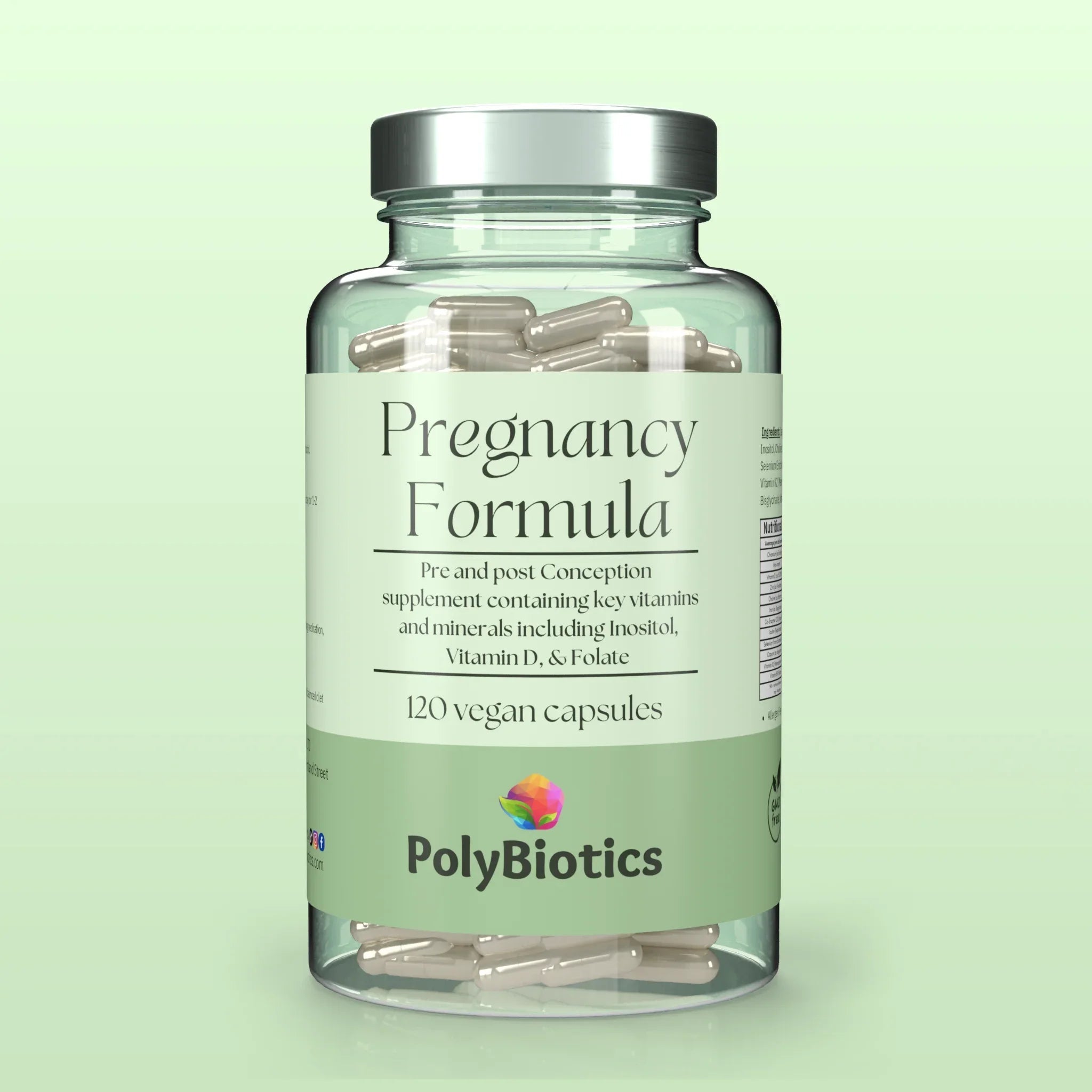
Our Pre & Post Conception Formula contains 2,000mg of myo-inositol alongside a B-vitamin complex, iron, zinc, chromium, vitamins K2 and D3, folate, choline, selenium, copper, iodine, and CoQ10.
*Food supplements should not be used as a substitute for a varied, balanced diet and a healthy lifestyle.
References
1. Clements RS Jr, Darnell B (1980). Myo-inositol content of common foods: development of a high-myo-inositol diet. Am J Clin Nutr 33(9):1954-1967.
2. Facchinetti F, Dante G, Neri I (2015). The Ratio of MI to DCI and Its Impact in the Treatment of Polycystic Ovary Syndrome: Experimental and Literature Evidences. In: Frontiers in Gynecological Endocrinology, Vol. 3. Springer. DOI: 10.1007/978-3-319-23865-4_13.
3. Baillargeon JP, Diamanti-Kandarakis E, Ostlund RE Jr, et al. (2006). Altered D-chiro-inositol urinary clearance in women with polycystic ovary syndrome. Diabetes Care 29(2):300-305.
4. Unfer V, Carlomagno G, Papaleo E, et al. (2014). Hyperinsulinemia alters myoinositol to D-chiroinositol ratio in the follicular fluid of patients with PCOS. Reprod Sci 21:854-858.
5. Nordio M, Basciani S, Camajani E (2019). The 40:1 myo-inositol/D-chiro-inositol plasma ratio is able to restore ovulation in PCOS patients: comparison with other ratios. Eur Rev Med Pharmacol Sci 23(12):5512-5521.
6. Update on the combination of myo-inositol/D-chiro-inositol for the treatment of polycystic ovary syndrome. Gynecol Endocrinol. 2023. DOI: 10.1080/09513590.2023.2301554.
7. Bizzarri M et al. (2023). Myo-inositol and D-chiro-inositol as modulators of ovary steroidogenesis: a narrative review. Nutrients.
Share:
0 comments
Blog posts
-

The Wellness Trends Women Should Question
Why some of today's biggest wellness trends are built on evidence that doesn't always reflect female physiology. By Dr. Amina Hersi MD Wellness trends have never been more popular. Open social media and you'll quickly be told that the healthiest...
-

Food vs supplements: this isn't a competition
Some brands compare their supplement's calories to breakfast, as if it's meant to replace food. It isn't. Here's what your diet gives you that no capsule can, and where the real gaps lie.
-

Is Stress Throwing Your Hormones Off? The Stressors We Don’t Always Think About
Stress isn't just about feeling overwhelmed. Heat, poor sleep, under-eating, over-exercising and major life changes can all place demands on the body. We explore how stress interacts with your hormones, what the science really says about childhood trauma and PCOS, and why building resilience, rather than trying to eliminate stress entirely, may be a more helpful approach.


